May

The first month of my journey was pretty eventful: family visited from out of town, our nanny was gone for two weeks, we took David to the ER for stitches (just 3 months after the last trip), Kate caught a cold and it passed through the whole family. It was also a transitional period. Kate finished school and hugged goodbye to her friends. We moved out of the house for a few days to have the basement asbestos tiles removed.  The heavy use of sunscreen announced the impending arrival of summer, along with its humidity.

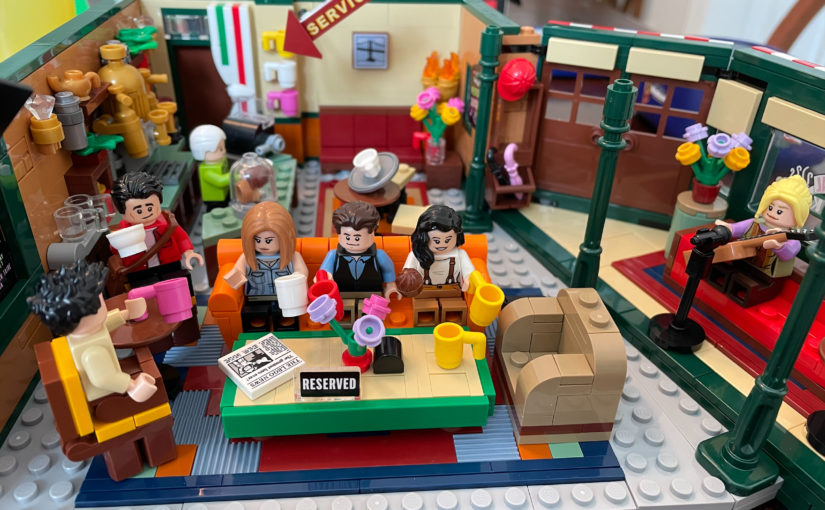
Given the unexpected sickness and loss of childcare, I had to take two weeks off from research. During the days I felt so miserable with a sore throat, I was in pure survival mode: nap, eat, Lego, and repeat. At least, I was not utterly unproductive.

Progress report:

Research: I started an empirical project on how the type of childcare affects development in early childhood. I will be using a restricted dataset that follows more than 6,000 kids from birth to kindergarten. So far, I read through the data manual and files, picked and cleaned the needed data, ran some preliminary regressions, had a meeting with a colleague who is an expert in empirical work, and formed a clear direction for the paper.

French: As we wrap up the French book we studied for a year and half, Aisela and I are switching to Coffee Break French. This is a great podcast for language learning. We have listened to the first 2 seasons (free version) already, and now purchased the member version of season 3 for its texts and more comprehensive lecture material. So far, I studied the first two episodes and have most of the texts memorized.

Reading: 3 books finished: All Creatures Great and Small; Mere Christianity; The Hitchhiker’s Guide to the Galaxy. They can’t be more different from each other. The first book is wholesome and pure. It puts a smile on your face, and you get quite a few good laughs. The last book is so odd in a good way. It reminds me of my teenage years when I was so into Sci-Fi stories that I even wrote one myself. My favorite out of the three books has to be C. S. Lewis’ Mere Christianity. I was simply blown away by his intellect. In this book, he broke down some hard concepts in Christianity into pieces that are so easy to understand and apply in life. He did it with clear logic and clean writing. He did it with an ease that  almost makes you think it is easy to do. I know I will be reading more of his work. 

Interior Solution

More than once I have been asked: “do you still have your babysitter come in the summer (when you don’t have classes)”? I always answer: “yes”, and quickly add, “I have to work on research.”

That answer is half true. The truthful part is I do spend quite a bit of time working on projects in the summer. The part that I tend not to reveal is that I also read, study French, go on lunch dates with Chris, and do Chinese grocery shopping when the babysitter is playing with my children. Part of me feels guilty. Shouldn’t I maximize my time with children, instead of pursuing leisure? Part of me feels wasteful. Shouldn’t I be a better saver by cutting unnecessary childcare expenses?

Child care, like cleaning, cooking, and elder care, can be seen as a form of home production. The work can be done by household members or by purchasing the service in the market. In my working paper, “Elder Care in an Aging Population: The Impact of Parental Care Needs on Adult Children“, I write: “In the standard home production models, the cost and preference to substitute home production with purchased services determine household consumption and time allocation decisions.”

The cost part is easy. If someone’s opportunity cost of time (usually measured by wage) is greater than the price of the service, she is more likely to outsource the work. That is why statistically, higher-wage mothers tend to work more and buy more child care. The preference part is tricky. How much time do you enjoy spending with your children, versus the next best alternative? I admire Emily Oster’s honesty in her answer. She writes in her book “Cribsheet”: “I’ve figured out that my happiness-maximizing allocation is something like eight hours of work and three hours of kids a day.” Even I, as a working mother, find that answer baffling, and almost cruel. But I don’t think I am too far from that. I love my children, but I don’t love spending all my time with them. I find myself much happier if I get away for a few hours.  In fact, I’m greatly enjoying one such break from them as I type these words.  I usually return refreshed and ready to play.

I don’t feel guilty about my preference. I do wonder if I am too selfish by acting on it. Somehow as soon as I became a parent, I felt this internal and external pressure to prioritize my children. Many times, my own needs and wants yield to theirs. But what is the guilt-free balanced point in these tradeoffs? There are numerous books on how to raise a happy child. Not a single one on how to become a happy parent. Do we still even matter?

In choosing between two goods/activities for utility maximization, if someone chooses all of one good and none of the other, economists call it a “corner solution”. Stay-at-home moms and full time working moms are both examples of this. If the chosen outcome is a combination of both goods, we call it an “interior solution”. I am grateful that my field allows me to choose such a solution.  I move my work around (such as grading in the evenings and research in the summer) so that I am away from children about 20 hours a week. In the summer, “work” often takes the form of reading, learning, and recharging. These things make me a happier and more relaxed person — at the cost of my less engaging parenting hours.  That’s a tradeoff I need not feel sheepish about.


What is Funner?

“What is funner, mom? Tell me the truth. Is it funner to be a child or an adult?” Out of nowhere, Kate popped this question during a bedtime chat. It is a good one.

There are definitely moments that I wish I was a child. For example, before leaving on a trip I find myself packing for two kids, two adults, cleaning up the fridge and ignoring work emails. Kate puts on her pink backpack and announces “I am ready!” When a family friend asks Kate, “What is your favorite subject at school?” Her eyes light up. With pride she says “Lunch.” When she saw me pleased with her handmade happy mother’s day card and a kombucha she bought with all her savings, she added, “It is nice to be a woman, huh?!”

Her world is so pure, fun and easy. I was tempted to give an easy answer to the question. Yes, as an adult, I know more about pain, anxiety, guilt, and a sense of loss at times. But I also fully enjoy my autonomy. I get to decide when to splurge on a cashmere sweater and when to bargain for a 10% teacher’s discount. More constraints are self-imposed as I age. Such as only one Marvel movie each week and no online shopping in the office (the former one takes 90% of my discipline). The children in our house rarely have something to say about what to have for dinner or where we go for a vacation.

The autonomy comes with responsibility and work. It is a fair trade to me.

Kate asked me to tell her the truth. So I told her: “It is nice to have both.”  Some days I long for the simplicity of childhood, but having tasted the freedom of adulthood, I wouldn’t go back.


The Grand Gesture

In his book “Deep Work”, Cal Newport writes of The Grand Gesture:

“By leveraging a radical change to your normal environment, coupled perhaps with a significant investment of effort or money, all dedicated toward supporting a deep work task, you increase the perceived importance of the task. This boost in importance reduces your minds instinct to procrastinate and delivers an injection of motivation and energy.”

French club is taking such a grand gesture. We are going to Montreal to practice French. Genuine interest was shown by five out of the six members at my announcement. Budget, time conflicts, and a newborn baby shorten the list of goers to two. Me and Aisela. No surprise.

We are the most consistent with our practice and learning. Together, we just finished the book “The Berlitz Self-Teacher–French”. All 41 lessons. We started from simple vocabularies (such as table, red, and 34) and sentences to most commonly used tenses (perfect, imperfect, and future) and more complicated structures. Our French is still pretty rough and we are slow as tortoises, but I am proud of this milestone. We did not give up.

I used to practice by saying the house numbers in French on walks. My whole family protests. There are times when I lay down with David for his afternoon nap, I tried to name the objects I see in the room. With his eyes closed, David murmurs: “No French.” During those tech talks Chris gives once in a while, my mind wanders off and starts conjugating “aller”. He catches me: “can you pay attention?”

Learning a language is quite like doing research. Hours and hours of work seem to produce nothing. I forgot that word AGAIN. The results are useless because there is a bug in the code. I don’t understand a thing when a French major student tries to tell me his summer plan. The referee can’t look past a model specification and thus rejects the paper three times. In both activities, the input and output relationship is so not linear.

What I learned is this. Focus on the inputs. That is the only way I don’t get frustrated or lose patience. The reward is right around the corner.  It always catches me by surprise.

In preparation for the trip, Aisela and I are meeting every week now to practice and provide accountability. The grand gesture seems to increase our motivation and learning speed. Worst case scenario, we are not able to catch Canadian French and converse with the locals. We will still wine and dine fabulously.


Buy Joy

Plenty of things in life cost very little, but bring me so much joy. Morning sunshine on a slow day, my kids’ fast and steady footsteps to my room, a nice walk in Ault Park, and watching Iron Man put on his suit (no marginal cost with a Disney+ subscription).

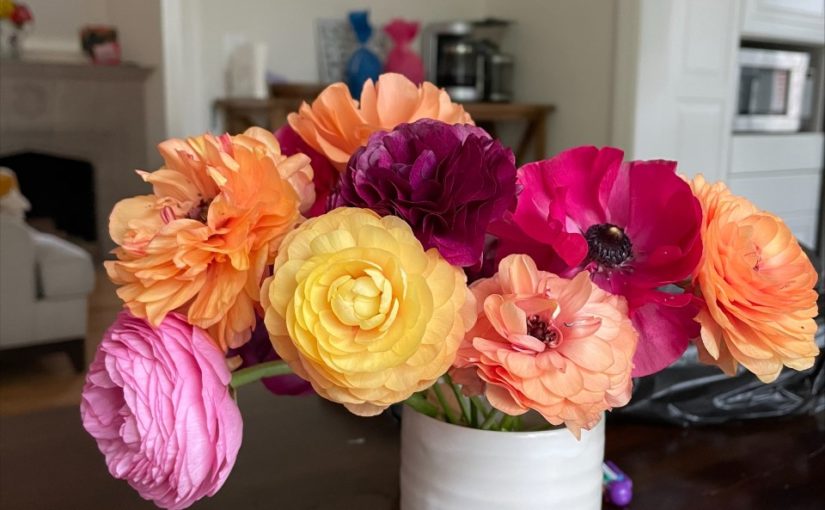
Out of the things I spend money on, nothing beats the joy per dollar provided by flowers. However, flowers seem such a luxury purchase. They are short-lived, not edible, and serve no practical function. But they never fail to spark joy in me. They are alive,  unexpectedly beautiful and unique with colors and shapes made by nature. They brighten the room and my mood. With an opportunity cost of two pounds of chicken, I always hesitate to put a bouquet in the grocery cart, but not once have I regretted it.

I have used Mother’s day as an excuse to get jewelry in the past. But this year, all I asked for from my family was flowers from the farmers market and a trip to my favorite bakery.  It was a money-saving and joy-enhancing choice.